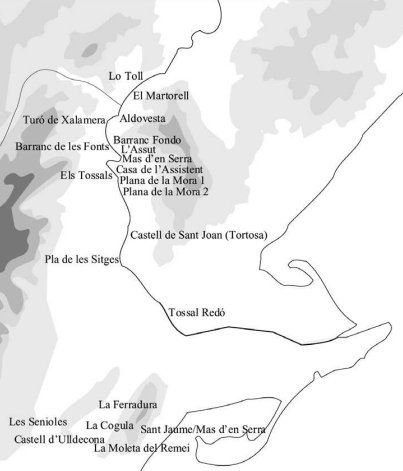
Site located right in front of the confluence of the Canaletes River with the Ebro. In the exploration work carried out in 1988, two rims of amphorae and remains of already oxidized Iberian ceramics were found together with a set of Phoenician imports. There are no remains of constructions, but the amount of surface material documented and its location, make the researchers call it an Iberian town. Regarding its chronology, the presence of Phoenician amphorae from the 7th century, a rim of a Punic-Ebusitan amphora from the 5th century and Italian material from the 5th century. II and I, suggest a prolonged occupation over time. There is no presence of silicified pottery, which suggests that the settlement was abandoned at the beginning of the high imperial period Its situation at a crossroads of communication routes together with the abundance of material from different periods and storage tools, suggest that it was a town that maintained commercial relations across the Ebro.
THE LLOMES
This site of very small dimensions was identified in 1997 by J. Diloli, about 500 meters north of Pont del Llaguter. The area is cultivated so the site is very deteriorated. Due to its situation, it is believed to correspond to the late republican period and the beginnings of the High Roman Empire. Remains of oxidized Iberian pottery, Campanian black-varnish pottery and, here yes, Hispanic terra sigilada pottery were found there. It is believed that this type of town was the origin of other later Roman cities and, in the Iberian period, they were usually found very close to other towns, in some cases, on Turó de l'Audí.
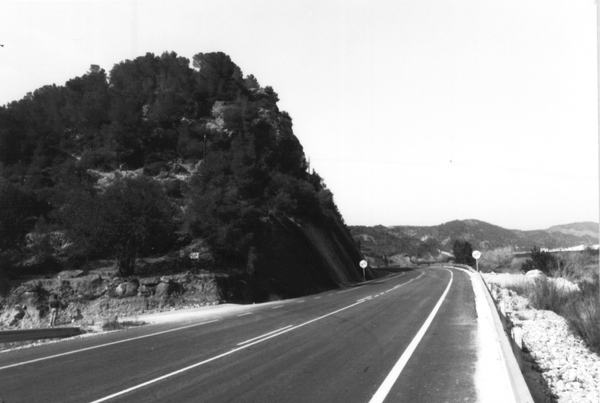
Ligallo de Líxem. Photo taken from the Archeology Drawer of the Generalitat de Catalunya (1992)
LIGALLO OF THE LÍXEM
Site identified in 1989 during prospective projections for the construction of the Eix de l'Ebre. Pavements, ashlars and remains of walls were identified. They found badly damaged remains of what appeared to be a Muslim necropolis and fragments of oxidized Iberian pottery, Hispanic terra cotta, African cooking pottery, Roman material... All this made the researchers think that this place was inhabited since from an indeterminate time in the Iberian period to the medieval period, most strongly during the Roman imperial period.
THE TOLL
In 1997, Diloli made the first description of this site located on a hill, next to a ravine bordering the current Benifallet - El Pinell de Brai road. The material found there consists of a large number of hand-made pottery characteristic of the early Iron Age, flat-based pottery with cord decoration, fragments of amphorae imitating Phoenician prototypes, some with remains of painting . But there is also material recognized from the Iberian period with archaic features, such as a jug with horizontal double-tendon handles, a flat lip and a slight molding on the rim. Undoubtedly, however, the most interesting find in this site was a fragment of the ridge of the back with a broken handle from an amphora that followed the Greek canon. Its characteristics, made of a reddish paste, led researchers to catalog it from the Corinthian period of the s. VI.
ROCK OF THE HANGING ONES
This site is located to the left of the Ebro, in the Barrufemes Gorge, south of what we know as l'Astet. It is a small rocky hill with construction remains at the top. It is probably a watchtower from the medieval period. For its construction, fragments of Iberian ceramics have been found mixed with the mortar. For this reason, one can think that it was already a watchtower in the Iberian period that was used with the same use in later periods.
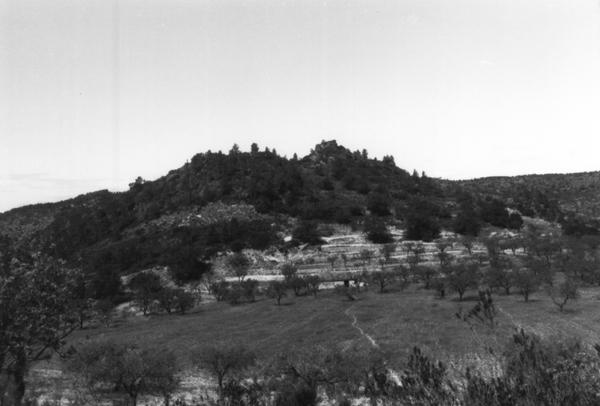
TURÓ DE L'AUDÍ
This site was not known until 1988 (Sanmartí and Santacana, 1990). At that time, its antiquity was defined by the presence of Phoenician amphorae, but also by material from the full Iberian period. Due to its geographical situation, it is believed that in the Iberian era it must have been used as a watchtower and/or defense, but no constructive remains have been found to confirm this. As in the case of the El Martorell site, agricultural cultivation and abundant vegetation have damaged what may be left of this site today. In any case, the large number of fragments corresponding to transport and storage containers suggest that this was a settlement of some importance in trade and distribution along the Ebro River.
Audi hill. Photo taken from the Archeology Drawer of the Generalitat de Catalunya (1992)
Extreme images of the document "Demographic evolution in the lower course of the Ebro during protohistory"
DILOLI FONS, J., BEA CASTAÑO, D. and SARDÀ SEUMA, S. Universitat Rovira i Virgili. Seminar on Protohistory and Archeology (GRESEPIA)
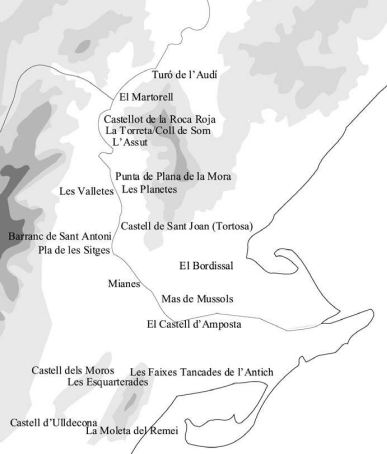
Lower course of the Riu Ebre between the s. V i II ANE
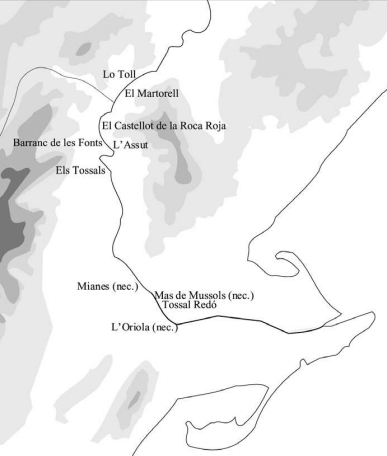
Lower course of the Riu Ebre in the 17th century. VI BNE
Lower course of the Riu Ebre in the 17th century. VII ANE