
CASTELLOT DE LA ROCA ROJA
SITUATION OF THE SETTLEMENT
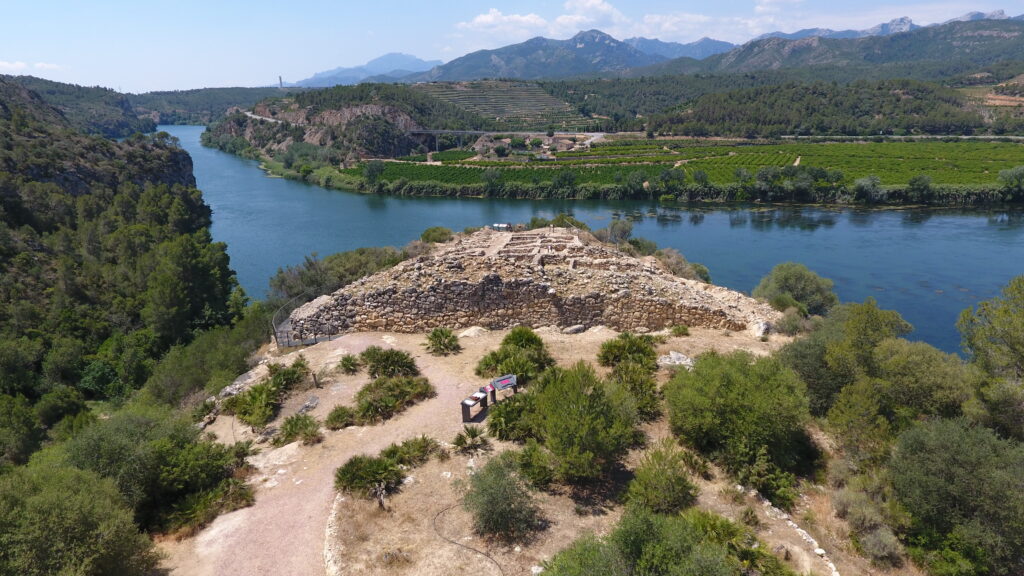
El Castellot de la Roca Roja is one of the best-preserved Iberian towns in Catalonia. It is located on a gorge of the Ebre River, about 15 km long between Miravet and Tivenys, sandwiched between the Cardó mountain range, to the east, and the foothills of the Beseit ports, to the west. The Iberian settlement is located on a rocky hill on the left bank of the Ebro approximately 40 meters above river level and 50 meters above sea level, occupying a totally strategic position, as it controls the passage of the Ebro River from a point where the river narrows and, in addition, it is located right in front of the mouth of the Barranc de Xalamera, a natural passageway to Terra Alta and Aragon that follows the current road T-333 from Eix de l'Ebre to Prat de Compte. For this same reason, it would be occupied during the Civil War by some military location that sought to protect itself from enemy fire on the other side of the river.
ARCHAEOLOGICAL EXCAVATIONS
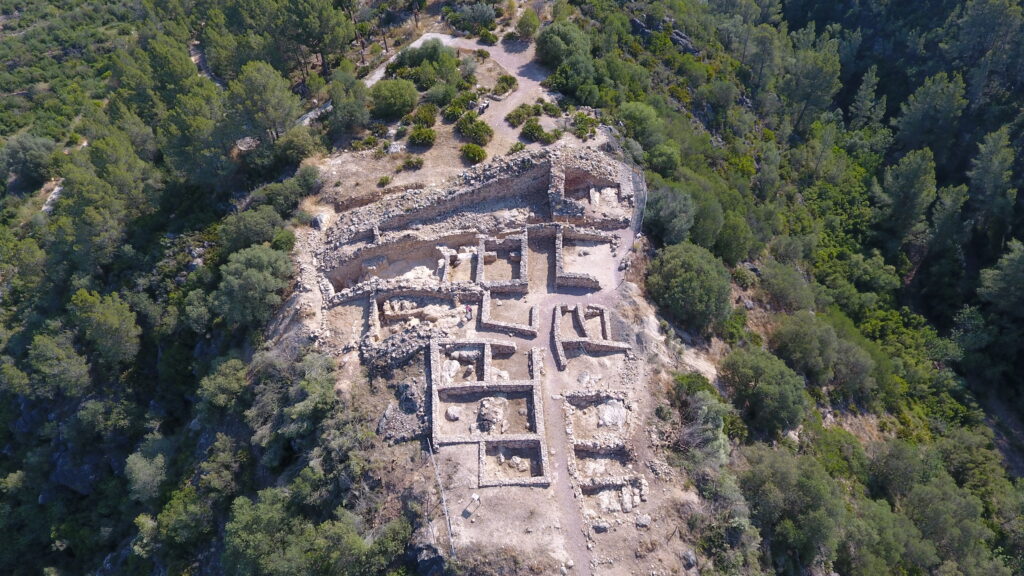
In the first instance, the site was illegally excavated by some anonymous hobbyist who left walls exposed, but neither the results nor the fate of the materials are known. This excavation would end up being detrimental to discovering the most recent history of this site. It would be in 1974 when the first archaeological excavations were carried out from a scientific point of view. They limited themselves to surveying the area to find out its chronology and make a provisional plan of the site (Izquierdo, Gimeno: 1990). Although the excavators published the results of the work, they did not include the study of the archaeological materials recovered, which had been deposited in the Archaeological Museum of Catalonia. Twenty-five years of oblivion would have to pass for the Benifallet Town Council to collaborate with the University of Barcelona during two campaigns: in February 1998 and 1999 funded by the Town Council, the Provincial Council of Tarragona and the Government of Catalonia. There would end up being three more campaigns, until 2002. The project combined a scientific aspect and heritage conservation. The scientific works were under the direction of Jaume Noguera and M. Carme Belarte; the recovery work had the direction of the Mallorcan restorer Margalida Munnar and the invaluable collaboration of Francisco Treig, Paco de Cabellera, a resident of Benifallet with a long experience in the reconstruction of dry stone walls.
ARCHAEOLOGICAL EXCAVATIONS
The cleaning, drawing, consolidation and excavation of the village made it possible to identify a relatively small settlement, triangular in shape, about 400 meters long by about 32 meters wide in the area of the wall, obtaining an area of less than 1,000 m2. We know very little about the first occupation of the Castellot de la Roja Roja, but a few indications show that there was a habitat before the constructions of the Iberian town that we can see today and that it probably consisted of a grouping of cabins. No construction belonging to this occupation has been identified, but there are cuts made in the rock, prior to the Iberian walls, which could have been pits related to these cabins. The sediment that refilled these cavities contained fragments of imported Greek cups from the end of the 6th century BC. At the end of the 5th century BC, the village of Castellot de la Roca Roja was built as we can see it today. The most impressive element of the settlement is the defensive system, consisting of a moat, a square tower located on the south side (where the entrance to the village is located) and a wall 30 meters long, 4 meters d 'width and _ in some places _ up to 4 meters of preserved height. This is a fairly common defensive system in antiquity because it forced the enemies to expose their right side, unprotected by the shield. The final stages of occupation of the town as well as its abandonment are the moments we know less about, since the excavations of the early 20th century affected precisely these strata. It was abandoned around 200 years BC, probably as a result of the conflicts of the second Punic war. This low area of the Ebro was strategically very important in the conflict that faced the Romans and Carthaginians and, without a doubt, a fortification like the Castellot de la Roca Roja was not alien to this confrontation. In any case, with the arrival of the Romans, their occupants and descendants went to work in farms or villas, such as the one discovered under the Pont del Llaguter, in Mas del Catxorro. The Roca Roja settlement is not an isolated case, as a whole network of settlements with similar characteristics has been identified in the lower course of the Ebro. All respond to the characteristics described for the Castellot: they occupy the extremities of the fluvial terraces or small hills next to the Ebro, with a very small surface area and with a tight urbanism that accommodated very small populations, of less than a hundred people

IBERIAN'S ROUTE
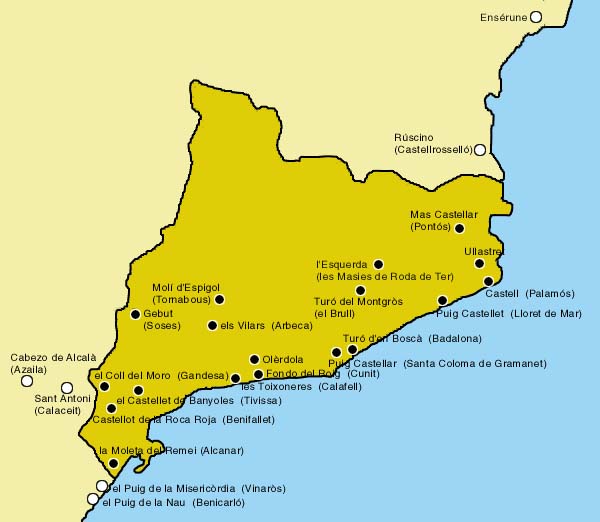
The Ruta dels Íbers, at the final stretch of the Ebro River, offers a fascinating journey through time, revealing the rich heritage of the area’s ancient inhabitants. This historical itinerary allows you to discover several archaeological sites that testify to the presence and development of Iberian cultures on the banks of the Ebro. Among these places, the Castellot de la Roca Roja, located in Benifallet, stands out in particular, a strategic enclave that was of great importance during the Iberian era. The remains of walls, towers and houses that can be seen there offer a clear view of how the Iberians lived and defended themselves, as well as their social and military organization.
Download the leaflet with important information for your visit to the Red Rock Castle
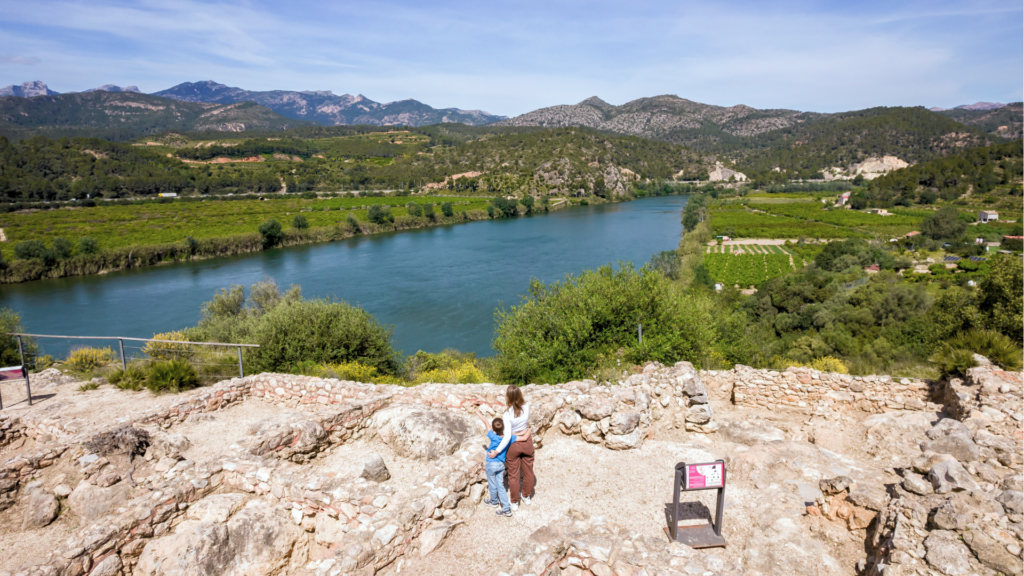
The visit to the Castellot de la Roca Roja is an enriching experience that allows visitors not only to contemplate the archaeological remains, but also to enjoy a privileged natural environment. From this hill, you can enjoy impressive panoramic views of the Ebro River and its surroundings, adding a landscape dimension to the historical importance of the site. It is a must-stop for anyone interested in the ancient history and cultural heritage of Catalonia.
Consult documentation about the site
If your interest goes beyond tourism, this page will not be of much help, so we leave you the links to some documents that will help you expand the information we provide here.
- ALCÁNTARA, R., ARNÁIZ, R. and SISA, J. "Contributions to the knowledge of recent prehistory in the lower section of the Ebro valley (Móra la Nova, Benifallet, Aldover and Flix): settlement dynamics in the "free air and in a cave". Tribune of Archeology 2017-18
- Bea, D.; Belarte, M. C.; Diloli, J.; Noguera, J.; Sardà, S. (eds.), "The fortified settlements of the lower course of the Ebro. V - III centuries BC .", Iberos del Ebro. Proceedings of the II International Congress (Alcañiz-Tivissa, from November 16 to 19, 2011), Documenta, 25, ICAC, Tarragona, p. 111-128.
- Belarte, M.C.; Noguera, J.; Santacana, J., "The museumization of the Castellot de la Roja Roja de Benifallet (Baix Ebre, Tarragona): reflections for a critical assessment" in Belarte, M. C.; Benavente, J. A.; Fatás, L.; Diloli, J.; Moret, P.; Noguera, J. (eds.), Iberos del Ebro. Proceedings of the II International Congress (Alcañiz-Tivissa, from November 16 to 19, 2011), Documenta, 25, ICAC, Tarragona, p. 375-384.
- Belarte, M.C.; Noguera, J., The Iberian site of Castellot de la Roja Roja (Benifallet, Baix Ebre). Archaeological guide , Catalan Institute of Classical Archeology - Benifallet Town Hall, Tarragona.
- Canela, J., "The Roca Roja Castle (Benifallet, Tarragona). The use of GIS, cartography and aerial photography in archaeological research " a Belarte, M. C.; Benavente, J. A.; Fatás, L.; Diloli, J.; Moret, P.; Noguera, J. (eds.), Iberos del Ebro. Actas del II Congreso Internacional (Alcañiz-Tivissa, from November 16 to 19, 2011), Documenta, 25, ICAC, Tarragona, p. 137-146.
- NOGUERA GUILLÉN, J. Genesis and evolution of the structure of the Iberian population in the lower reaches of the Ebro River: Northern Ilercavonia. Volume I. 2006. pp. 156-158
- News from the last excavation campaign in the Iberian town of Castellot de la Roca Roja (Benifallet, Baix Ebre). June 2017. Archeology Tribune.