From 6,50€
/persona
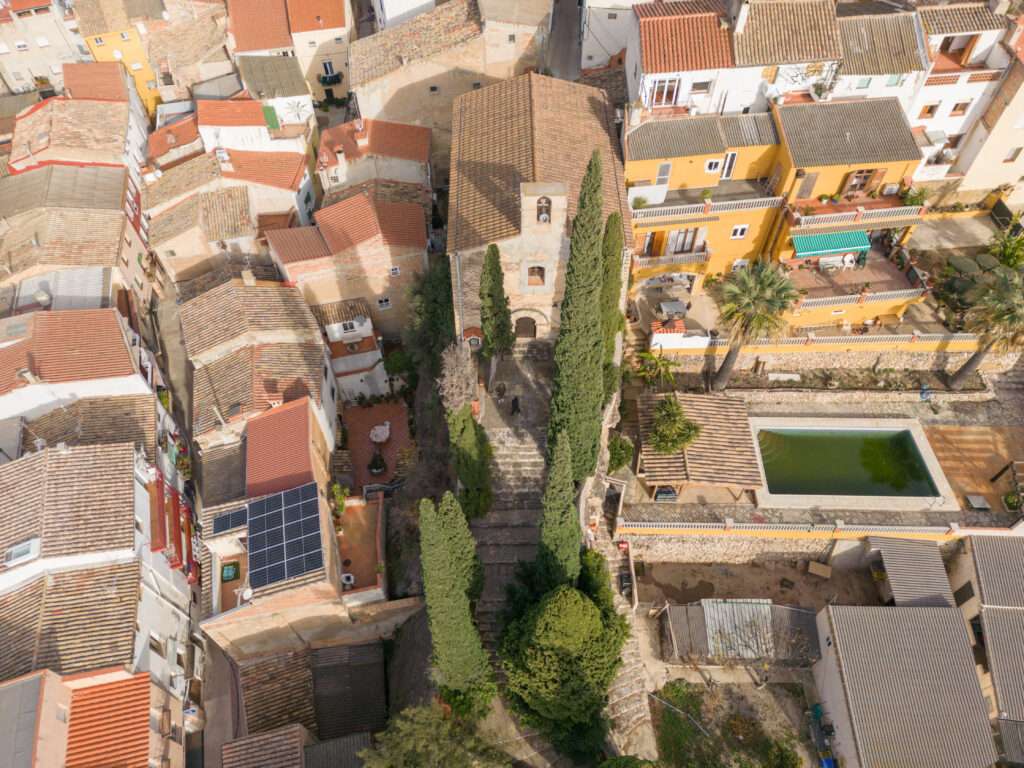
The exact moment of its construction is unknown, plus its location a few meters from the old castle, documented at the beginning of the 13th century and of which only part of an arch and small pieces of the perimeter wall remain, suggests that it could being a military chapel. After the conquest of Tortosa by the forces of Ramon Berenguer IV, in 1148-1149, the lands were distributed among its nobles. One of these was Berenguer Pinyol to whom he ceded the Lloc de Costumà, near Benifallet. Around 1228, Bernat Pinyol, a descendant of the previous one, expanded his territory by purchasing the Places of Sallent and Cardó from the widow of Bernat Olivar Fuster. The Pinyols continued to be lords of the Barony of Cardó possibly until 1417 when it passed to the abbot of the monastery of Benifassà. The Barony of Costumà came under the jurisdiction of the city of Tortosa around the year 1491 by order of Ferdinand the Catholic. We do not find any reference to the church until 1279, when it is reported that the town priest contributed to the papal tithe. It is a late Romanesque building typical of the medieval Christian architecture of the Ebro region and linked to the military orders that participated in the Christian conquest (Tortosa, 1148). It is a single-nave building, with a rectangular plan without apses, made with regular-sized stone ashlars and a double-sided roof.
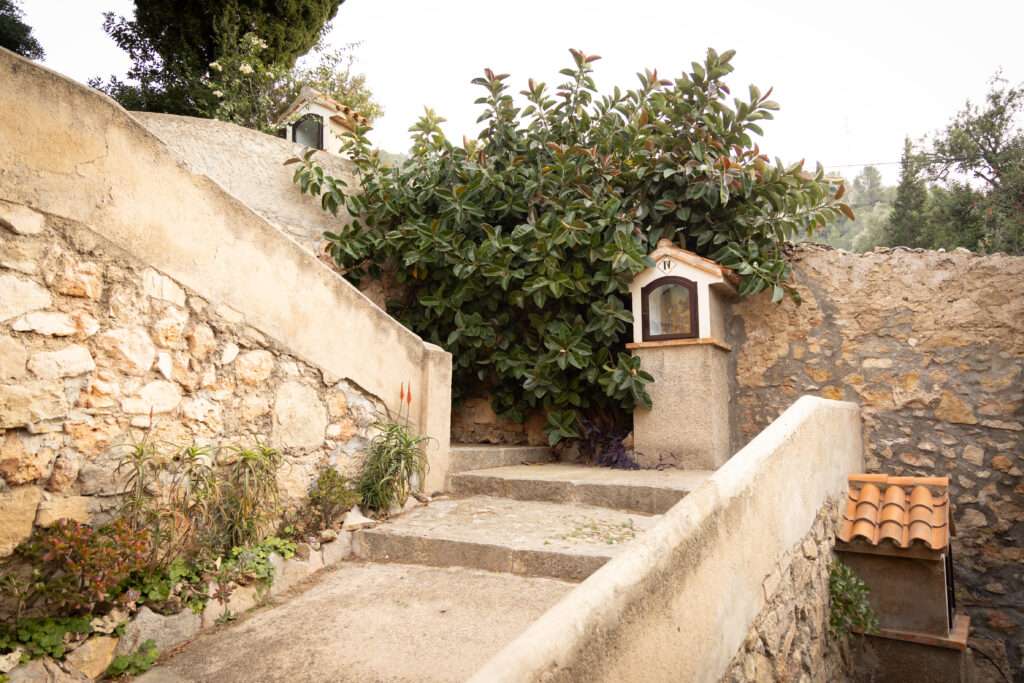
The old parish church of Santa Maria – also known as Ermita de la Mare de deu de dalt or Nativity de la Mare de Déu – is located in the upper part of the town, at the southern end of the cliff that separates the primitive center and next to the old cemetery, currently converted into farmland. The main access is via a Way of the Cross that starts at Carrer Escaleta and zigzags up to the top of the cliff. There is another entrance, from the back of the building, which connects to Carrer Ermita. When we access via Carrer Escaleta we can enjoy the representations of the life of Jesus Christ along the steps of Calvary. Along the steps of the Calvary we find chapels with a rectangular base with a maximum height of about 105 cm where we find the steps of the Way of the Cross represented (Cirst's first fall under the weight of the cross). The scenes in high relief, which seem to be made of plaster, are protected by glass (except in chapel VII, which is broken, and in VI, IX and XIV, which have disappeared). All the wooden parts of these windows and the metal parts (lips and hinges) are also deteriorated. They were rebuilt in 1960, although the entire urban element is much earlier.
The main and original door of the temple is made in a perfectly vaulted semi-circular arch. Above it, slightly displaced, is the one-eyed bell tower. A second door, opened after the construction of the building (in 1861 according to the indicative plate) leads to Carrer de l'Ermita. Inside the building, covered with a pointed vault, we can enjoy the image of Our Lady of Above, patron saint of Benifallet, located in the presbytery. At the foot of the church is the choir covered with a coffered ceiling. Open to the thickness of the wall, the Pinyols had their graves in the 13th and 14th centuries. At present only the primitive heraldic arms of the family with Latin inscriptions can be distinguished. In the hermitage there are fresco paintings related to the time of the construction of the church.

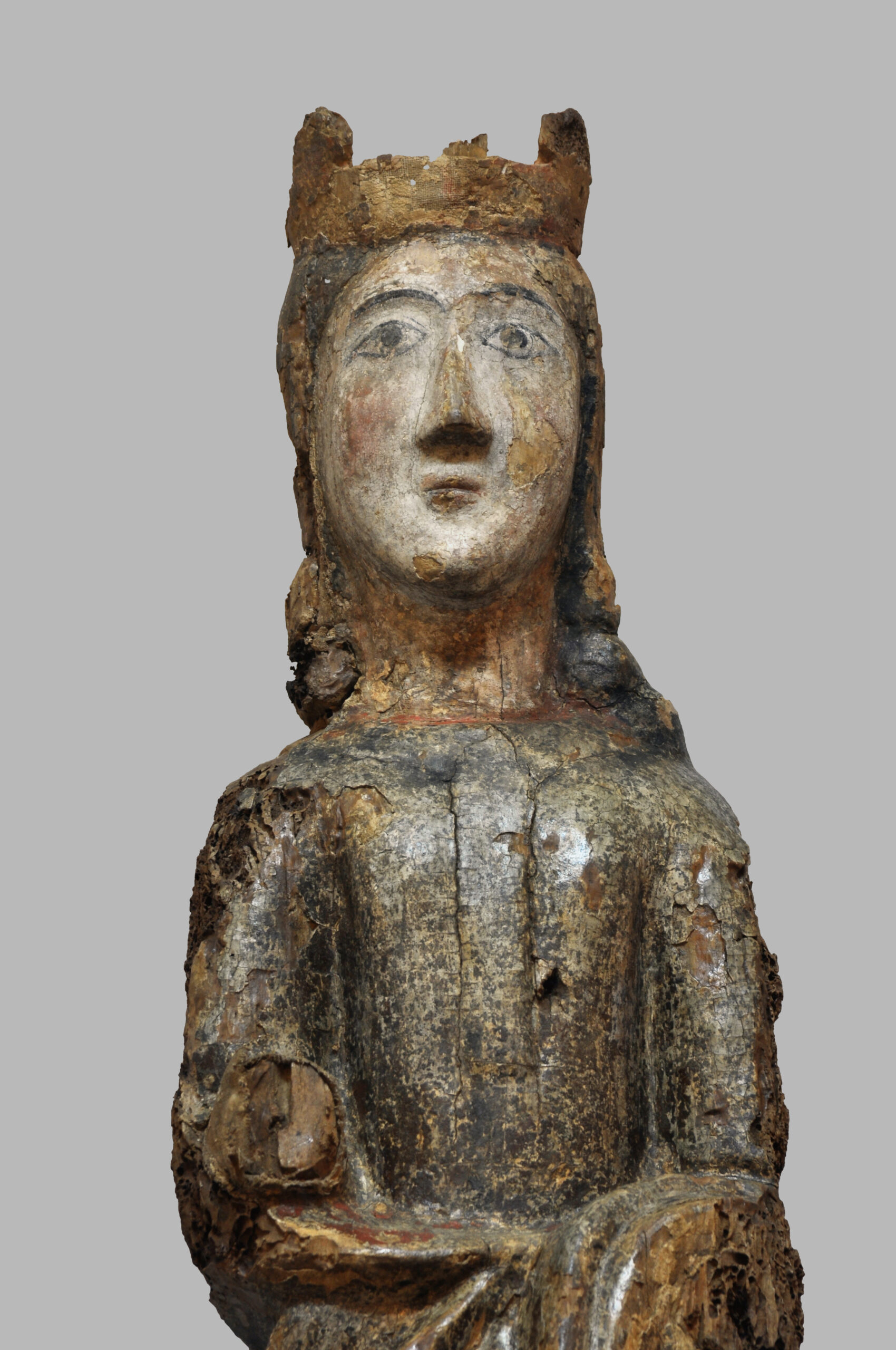
In an archaeological intervention carried out in 2006 on the occasion of works carried out by the Benifallet Town Council, a wooden carving of the Virgin and Child appeared dating from the s. XIII.
A getaway to Benifallet is a unique opportunity to connect with nature and the history of our town. Come and enjoy everything that Terres de l'Ebre has to offer.
Av. Lluís Companys, 6 – Benifallet