
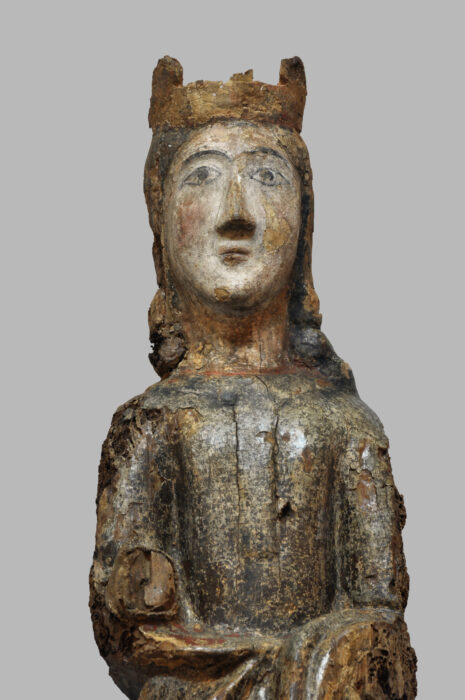
In an archaeological intervention carried out in 2006 as part of works carried out by the Benifallet City Council, a wood carving of the Virgin and Child dated from the 13th century. Il s’agit d’une sculpture sur bois polychrome de transition entre le roman et le gothique, un fait exceptionnel, selon les experts, car l’art liturgique roman est pratiquement inexistant dans les Terres de l’Èbre et en Catalogne Nouvelle en général. Son caractère unique a provoqué une nouvelle intervention archéologique dans laquelle une nécropole utilisée entre le s. XIII et XVII.
The statue, 86 centimeters high by 35 centimeters wide, represents the crowned Virgin Mary, in a very hieratic frontal position, a characteristic feature of the Romanesque. On the other hand, the folds of the tunic and the fact that the Virgin is holding the mantle with her left hand are characteristics more typical of the Gothic style. Her right hand is missing, and everything suggests that she was holding the baby Jesus, who has also disappeared.
There is an inventory of the art and the diocese of Tortosa that was carried out in 1935 by Father Manuel Milian Boix where he spoke of a wooden carving of the Virgin of Benifallet that the religious dated from the 14th century, and specified that everything indicated that it had been repainted. Thus, the most possible is that this Virgin Mary found was hidden during the Civil War under the floor of the hermitage. What is surprising is that after the war no one remembered it anymore. Chance made it reappear, as a result of routine work to change the floor of the hermitage.
Archaeologist Joan Martínez defines this piece as “unique and exceptional” due to the rarity of finding Romanesque pieces in New Catalonia because the Romanesque of the Boí Valley and Old Catalonia had not yet arrived, since here we were in all the splendor of Al-Andalus.
The piece was restored at the Restoration Center of the Ministry of Culture in Valldoreix (Barcelona) and, later, on January 31, 2009, it was installed in a security display case in a side chapel of the parish church of Benifallet. The parish church _in the center of the town_ was chosen instead of the altar of the hermitage, the original space of the carving, for security reasons.